← Back to Worked Examples

Practice Questions - 2
Subject: Physics | Grade: 11 | Topic: Newton's Laws of Motion
Practice Questions
PRACTICE QUESTION 15
Determine the distance from Earth at which the gravitational forces exerted by the Earth and the Sun on a rocket balance each other.
The distance between Earth and the Sun is 15 × 107 km, and the mass of the Sun is 2 × 1030 kg.
PRACTICE QUESTION 16
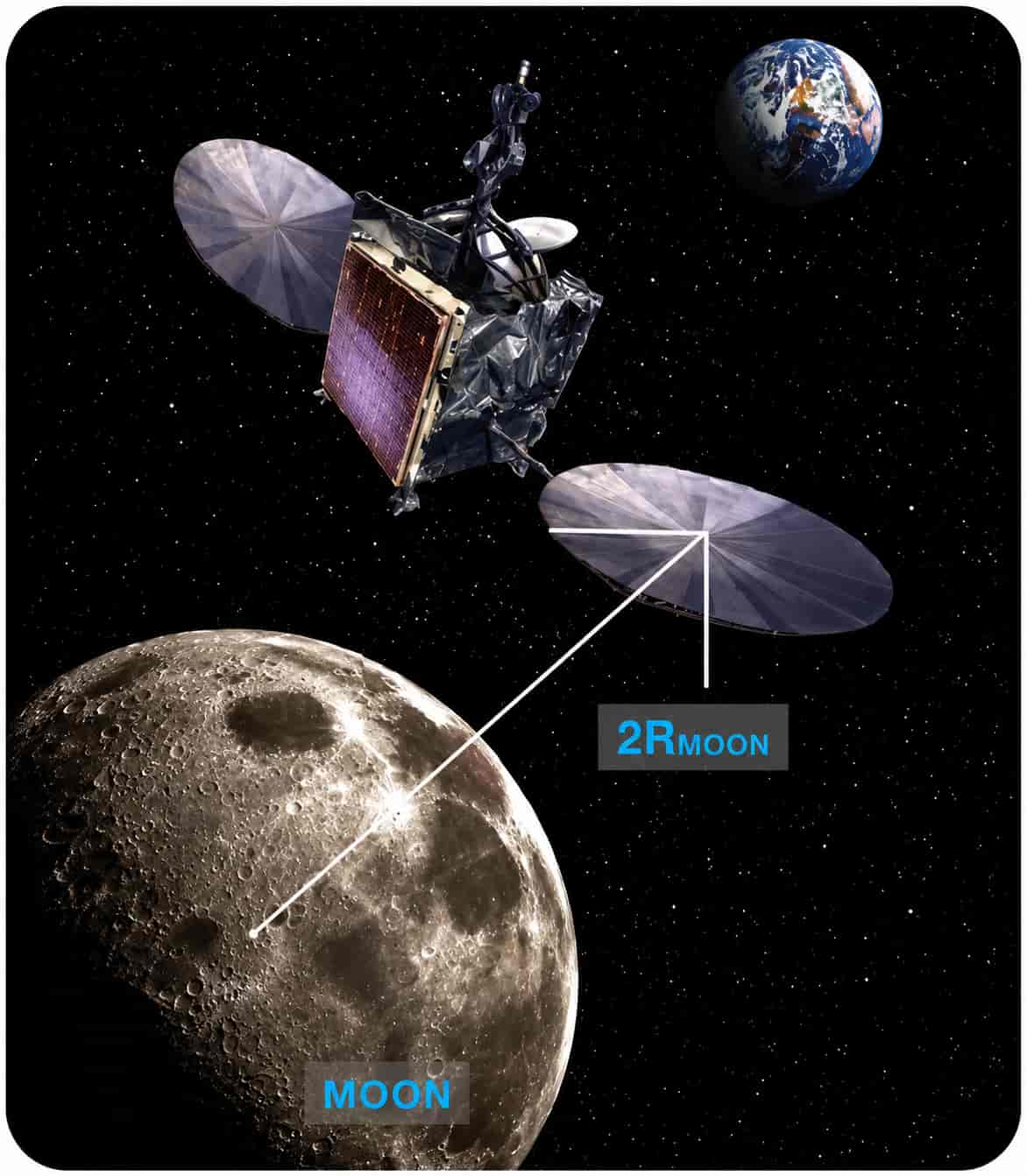
The weight of a space probe on the Moon is 6800 N.
16.1 If the gravitational field strength on the Moon is approximately 1.7 N kg-1, what is the mass of the space probe?
16.2 What is the gravitational force on the space probe while it is orbiting the Moon at twice the Moon's radius from the Moon's center? The radius of the Moon is 1737.4 km.
16.2 What is the gravitational force on the space probe while it is orbiting the Moon at twice the Moon's radius from the Moon's center? The radius of the Moon is 1737.4 km.
PRACTICE QUESTION 17
A force T = 248 N is required to keep a body of unknown mass at rest on a frictionless slope that makes an angle of 38° with the horizontal. The forces acting on the body are shown in the diagram below.
17.1 Name the forces N and W.
17.2 Explain why the body remains at rest.
17.3 Calculate the magnitude of the force W.
17.4 Calculate the magnitude of the force N.
17.2 Explain why the body remains at rest.
17.3 Calculate the magnitude of the force W.
17.4 Calculate the magnitude of the force N.
PRACTICE QUESTION 18
A mass of 2 kg is placed on an inclined plane with an inclination angle of 30°. How much horizontal force should be applied to the mass so that it moves uniformly up the inclined plane? The coefficient of friction between the mass and the surface is 0.3.
PRACTICE QUESTION 19
A child of mass 25 kg is in a car moving at 20 m s-1. The child is wearing a seat belt. A box is on the seat next to the child. There is no friction between the seat and the box. The car suddenly brakes.
19.1 Describe how the box moves immediately after the brakes are applied.
19.2 Describe how the child moves immediately after the brakes are applied.
19.3 Calculate the magnitude of the resultant force acting on the child when the car brakes from 20 m s-1 to rest in 4.0 s.
19.2 Describe how the child moves immediately after the brakes are applied.
19.3 Calculate the magnitude of the resultant force acting on the child when the car brakes from 20 m s-1 to rest in 4.0 s.
PRACTICE QUESTION 20
Julius stands on a bathroom scale in a lift. His weight is 637 N when the lift is stationary. What will the scale read if:
20.1 the lift is ascending at a constant speed of 1 m s-1?
20.2 the lift is ascending with a constant acceleration of 2 m s-2?
20.3 the lift is descending with a constant acceleration of 1 m s-2?
20.2 the lift is ascending with a constant acceleration of 2 m s-2?
20.3 the lift is descending with a constant acceleration of 1 m s-2?
PRACTICE QUESTION 21
An 8 kg wooden block is attached to a 2 kg wooden block by a lightweight inextensible string passing over a frictionless pulley. The 2 kg block accelerates up a rough inclined plane from the bottom of the incline when the 8 kg block is released from the top of the incline, 5 m above the ground. A constant frictional force of 20 N acts on the 2 kg block. Ignore air resistance.
21.1 State, in words, Newton's second law of motion.
21.2 Draw a labelled force diagram of all forces acting on the 2 kg block.
21.3 Calculate the coefficient of kinetic friction if the 2 kg block slides up a steep slope.
21.4 Determine the magnitude of the tension in the string.
21.5 Calculate the speed of the 8 kg block when it strikes the ground.
21.2 Draw a labelled force diagram of all forces acting on the 2 kg block.
21.3 Calculate the coefficient of kinetic friction if the 2 kg block slides up a steep slope.
21.4 Determine the magnitude of the tension in the string.
21.5 Calculate the speed of the 8 kg block when it strikes the ground.
PRACTICE QUESTION 22
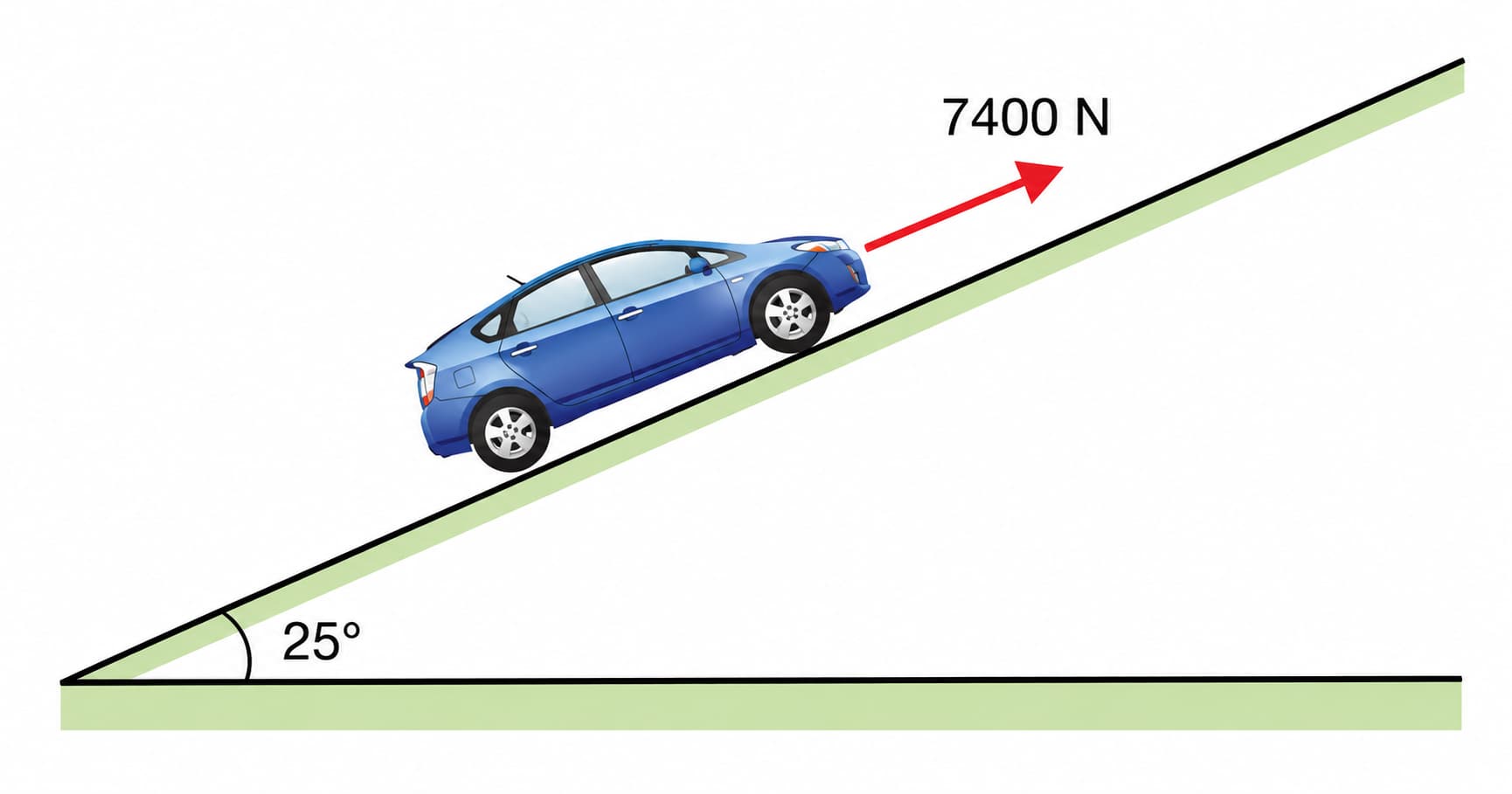
A car with a mass of 1400 kg accelerates up a hill while experiencing a net force of 7400 N. The hill makes an angle of 25° with the horizontal, and the coefficient of kinetic friction is 0.23.
22.1 Draw a labelled free-body diagram of all the forces acting on the car.
Calculate:
22.2 the magnitude of the friction force.
22.3 the applied force.
Calculate:
22.2 the magnitude of the friction force.
22.3 the applied force.
PRACTICE QUESTION 23
Two masses of 5 kg and 3 kg are connected by a string that passes over a pulley. The table surface exerts a constant frictional force of 10 N on the 5 kg mass. Ignore the mass of the string. The diagram below illustrates the situation.
23.1 Draw a labelled force diagram to show all the forces acting:
23.1.1 vertically on the 3 kg mass.
23.1.2 horizontally on the 5 kg mass.
Calculate:
23.2.1 the magnitude of the acceleration of the masses.
23.2.2 the tension in the string.
23.1.1 vertically on the 3 kg mass.
23.1.2 horizontally on the 5 kg mass.
Calculate:
23.2.1 the magnitude of the acceleration of the masses.
23.2.2 the tension in the string.